Peak Management In Industrial Contexts
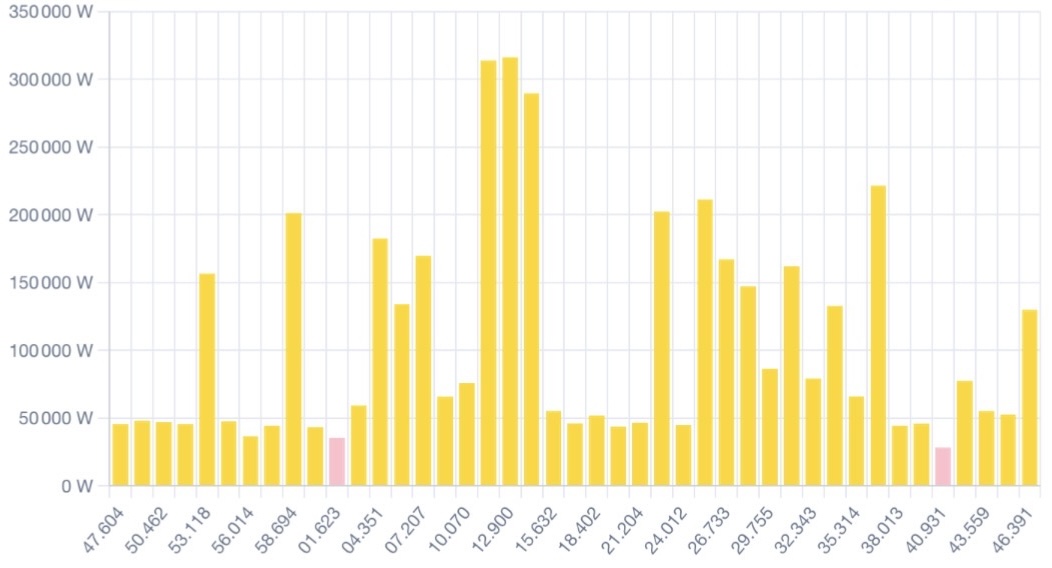
A 60-seconds window showing the power meter of a factory employing cranes and welding equipment. The labels are in seconds.milliseconds. The bars show the power in W and demonstrates fast peaks up to plus 250 000 W over the base load of 50 000 W appearing and disappearing within seconds. The base load has already been reduced by 200 000 W with the help of solar energy. Without the solar energy support the base load is 250 000 W and the fast peaks reach 550 000 W.
Audience
This article is written for professionals in industrial organisations, who are responsible, formally or informally, for the purchase and use of energy.
These responsibilities may lie with different roles in different organisations.
Emerging aspects of these responsibilities may challenge and even overwhelm some of those professionals.
This article is especially aimed at them.
Goal of this Article
Illustrate why peaks should be managed, the different types of peaks and some of the most typical ways to manage peaks.
Sources
This article is loosely based on the author's magnum opus — the Handbook — How to Ask and Answer Questions Related to Renewable Energy In Industrial Contexts.
The data and the charts are taken from an actual factory.
The author has implemented a number of peak management solutions in industrial contexts.
No Association
Neither endorsement, nor fitness for purpose is applied to any of the solutions mentioned in this article.
All examples are for illustration purposes only and are selected based on their merit.
Management vs Shaving
Peak shaving is a colloquial name for one of the aspects of peak management, the reduction of peaks.
Peak Management
The activity of managing peaks by managing either the industrial equipment causing them, a supporting equipment that lowers them or both.
Reasons to Manage Peaks
Peaks may cross a number of limits.
Some of the limits may be set by the energy contract(s). Some by fuses or circuit breakers. And some, individually or as a combination of the afore mentioned, may be limits imposed on the operation of equipment and therefore — on industrial processes.
Limits
Limits Imposed by the Energy Infrastructure
One of the main sources of limits in industrial contexts are the grid operators.
These limits are typically two kinds —
- Peak Power Limit (W), and
- Energy Over a Period of Time Limit (Wh).
Power vs Energy
These simple terms are surprisingly seldom understood.
Here is a brief explanation.
Power (W, Watts) is the rate at which electricity is used or produced at any moment. Power can be compared to the speed of a car.
Energy (Wh, Watt-hours) is the total amount of electricity, which is used over time. Energy can be compared to the distance travelled by car.
From another perspective power is a snapshot and energy is the accumulation over time.
From yet another perspective power is how much water flows throuh a pipe and energy is the total amount of water that has flown through the pipe for a given period of time.
Peak Power Limit (W)
Here again the chart from above. The factory has a kW peak limit of 1 750 kW.
The Peak Power Limit (W) limits consumption and/or delivery above the limit even for a short period of time.
Exceeding the Peak Power Limit (W) may lead to circuit breakers opening to protect the grid.
The industrial site may, as a result, lose grid power.
Additionally, there could be penalties.
Energy Over a Period of Time Limit (Wh)
The Energy Over a Period of Time Limit limits the consumption or delivery not in a peak, but in a temporal manner.
The Energy Over a Period of Time Limit for our factory is calculated the following way. The factory has an Energy Over a Period of Time Limit of 398 000 Wh. The factory is not allowed to exceed 1/4 of that limit, or 99 500 Wh, during any 15 minutes period.
Grid Limits as a Bargaining Chip
The Grid Limits may be a bargaining chip in complex negotiations.
Our example factory can form an energy hub with a neighbouring factory in order to exchange excess electrical energy.
The grid operator is ready to allow that, but will then lower the limits of both companies. The lowered limits will fall under the minimum needs of the example factory to operate. This makes the hub possibility impossible to implement.
Limits Imposed by Fuses and Circuit Breakers
Fuses and circuit breakers are another reason to manage peaks.
In another example a site has large water heaters, which consume more energy, than the fuses/ciruit breaksers can handle.
Prioritisation
The limits on peaks may lead to the impossibility to operate equipment needed for the industrial processes.
The peak management in this case might require re-design of the industrial process.
Limits and a Broader Context
Not all necessities are transformed into limits.
A good energy management strategy looks beyond the present and into an unpredictable future.
"No one can predict the future," says Uto Baader, the 82 years old German banker in the beginning of his openings.
Yes, one can navigate it.
"Change before you have to," used to say
Peaks
Kinds of Peaks
In Industrial Context there are two major kinds of peaks.
Fast Peaks
The Fast Peaks are caused by equipment such a cranes and welding equipment.
A crane may have 4 x 5 kW electrical motors to move and 2 x 50 kW electrical motors to lift, and can move and lift at the same time, therefore generating 120 kW at the push of a button.
Here we show the chart from above for a third time. Some of the fast peaks are caused by cranes.
Slow Peaks
The Slow Peaks are caused by engaging equipment which stays in operation for longer periods of time. Like in the example above, where large water heaters must operate for several hours.
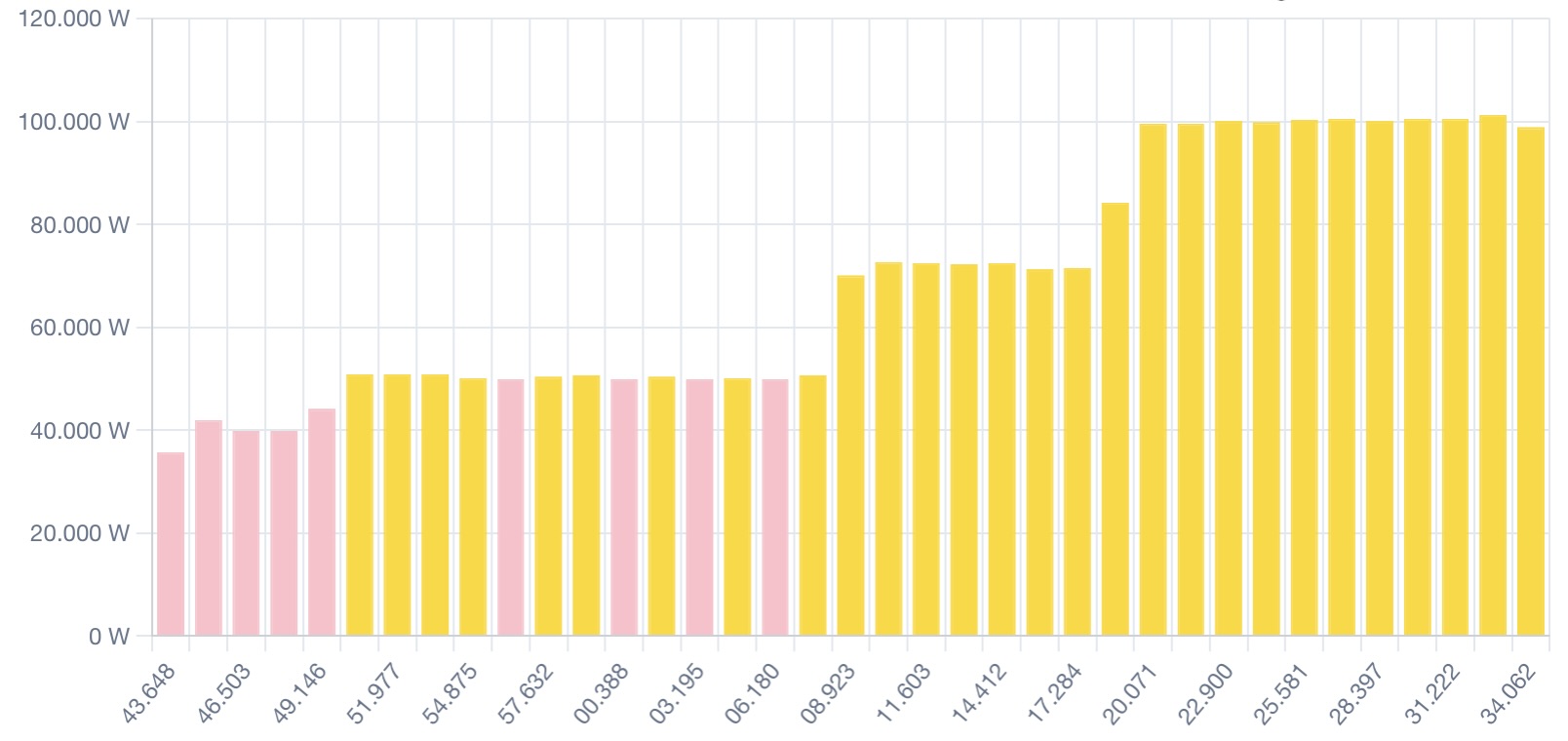
A 60-seconds window showing the power meter of a factory. The labels are seconds.milliseconds. The bars show the power in kW and demonstrate the development of a slow peak from about 40 kW to about 100 kW over the period of about 30 seconds.
Peak Management
In this section we will see how management of peaks is done. The approach to management of peaks depends on the reasons and on the overall goals.
Strategies
Peak management requires a strategy.
The simples and most popular strategy is the curtailment of photovoltaic output. When the sun shines and all photovoltaic sites in a given area produce, the grid operator may limit the delivery to the grid. Since electricity is not like water and one cannot simply turn the valve. One needs to instruct the inverters to produce less electricity.
Depending on the source of peaks and on the reasons to manage them, different strategies can be developed.
Implementations
The implementation of the strategy needs design of logic, an energy management software and a steering equipment.
Logic
The logic can be simple or complex.
Control Theory
An important fact about steering industrial equipment is that not infrequently has reaction time and reaction pattern.
Not infrequently, both must be taken into account.
For example, sending a steering command should be followed by a waiting time, which gives the system a chance to reach the desired state. Not doing that may lead to oversteering, or bringing the system to a state beyond the desired state.
Upon receiving a steering command the system may or may not reach the desired state. This can happen for a number of reasons, one of which is that it might not have the resources to do that or because it has a mind of its own and therefore follows additional rules.
All these factors are to be considered, when designing a peak management strategy.
An Industrial Controller
In all cases, the management of the peaks involves an industrial controller, which is capable of communicating with the equipment involved in the management of the peaks.
Energy Management Software
The controller runs energy management software, which implements the strategy by applying rules via steering commands sent to the equipment involved in the management of the peaks.
Prior to this, the controller conducts measurements, which form the basis of the decisions the controller makes and of the commands the controller sends.
Emergency Control
When one manages peaks with the help of, for example, batteries, one needs emergency control over the load, which is causing the peaks.
The reason for this is that the batteries may discharge before the end of the peak interval ends, which might lead to damage caused by the unsupported peak load.
To prevent such a damage the controller must be able to terminate the load-causing equipment. This may be possible or impossible, in which case the controller must be able to raise an alarm.
Termination of load causing equipment can be done with direct control, in cases where the equipment supports it. Or with a simple relay that simply interrupts the power supply that equipment. A brutal, but effective in some cases way.
Managing vs Not Managing
When peaks do not exceed one or more of the limits imposed on the industria site, they do not need to be managed.
Related to the Peak Limit vs Limit over Time.
Management of Fast Peaks. Kinetic Solutions
Teraloop.
Questions?
If you have any questions, please feel free to contact the authors of this article.
Meet the Author
At SPS in Nürnberg in October.
Copyright
All rights belong to the authors.
The article can be reproduced as a whole or in parts as long as the original title and the authors are mentioned and a link to this page is provided.