The Grid
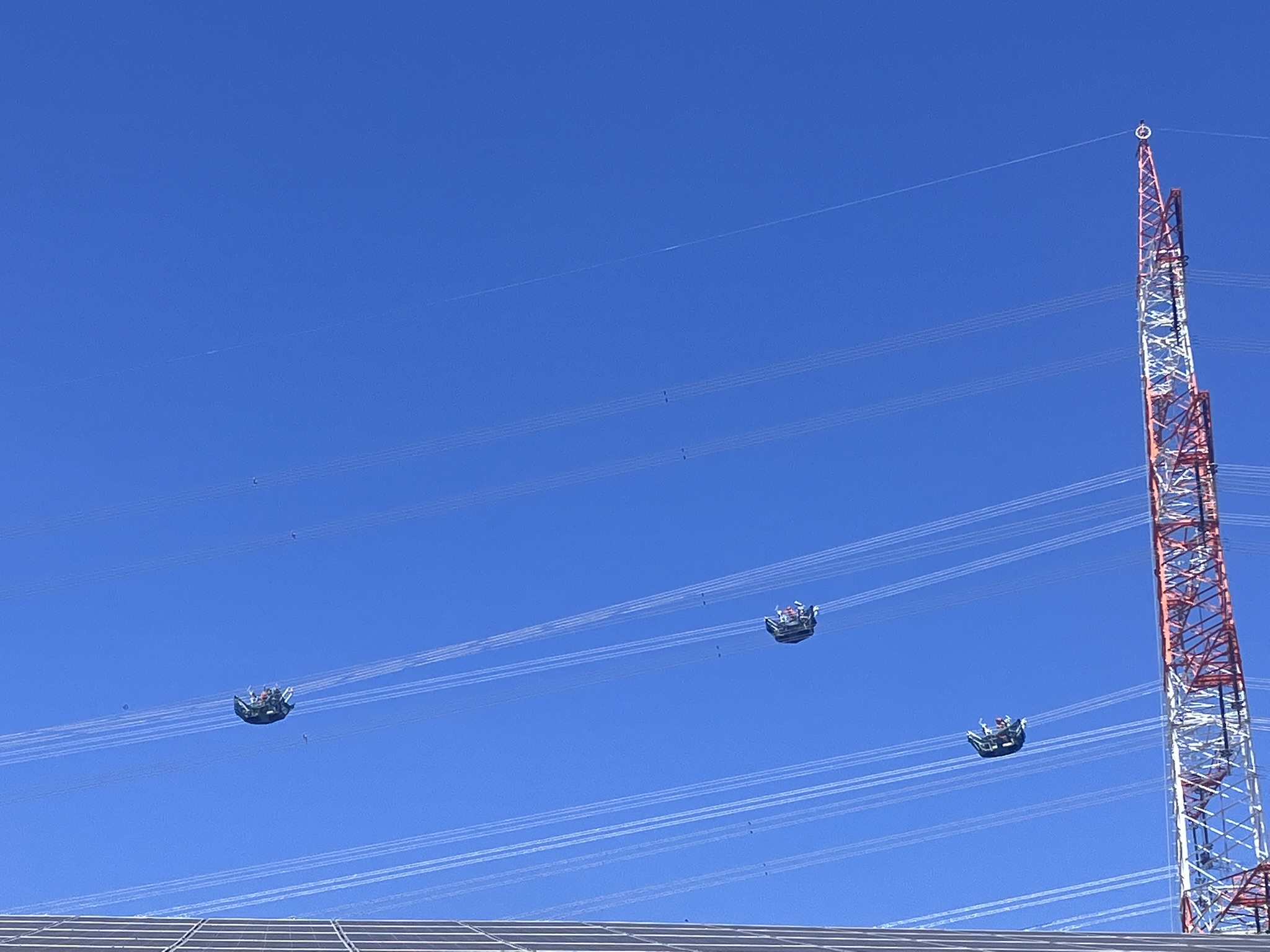
Workers performing maintenance by riding in gondolas under high-voltage lines near the author's home in Darmstadt, Germany.
Audience
This article is written for professionals responsible for the purchase and use of energy in industrial contexts.
Lie-to-Children
In order to keep the article short and interesting, some complex topics are simplified.
The detailed story is available in my magnum opus — the Handbook — How to Ask and Answer Questions Related to Renewable Energy In Industrial Contexts.
The Grid?
The electrical grid.
Why talk about the Grid?
The Grid is a major factor in energy and will play an important role in the future. A role, which already affects and will affect everyone in industrial contexts. Its nature and upcoming changes should be, therefore, understood and taken into account.
What is the Grid?
The Grid is the infrastructure connecting in-front-of-the-meter sources of energy the behind-the-meter consumption. Over short, long and very long distances.
A Short History of the Grid
The Grid was not designed. It grew, step by step, and each step left something we still live with today.
In the Beginning: No Grid
There was no Grid. Energy was made where it was used.
A factory had its own steam engine. Shafts and leather belts carried the power to the machines. Light came from gas, oil and candles.
1860s: One Generator, One User
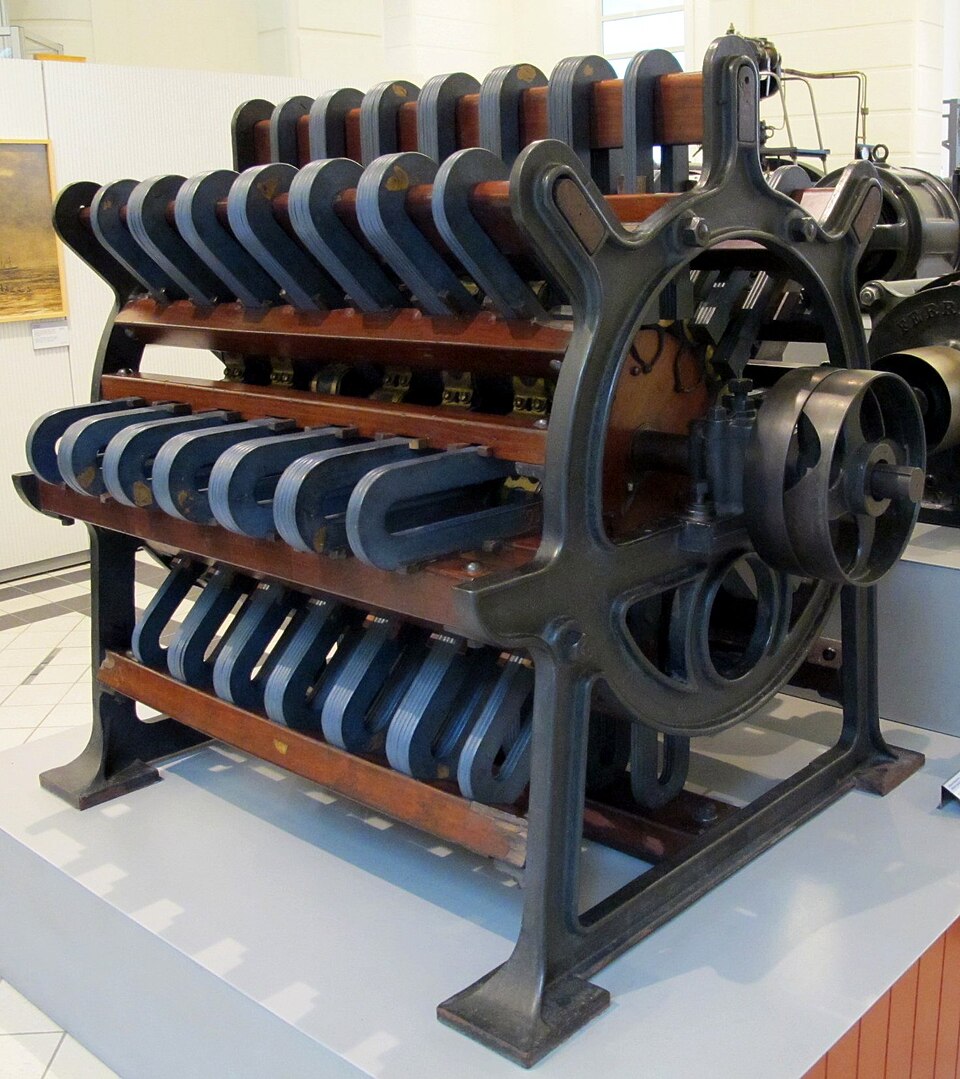
An Alliance machine, the generator that grew out of Floris Nollet’s design. In the 1860s such machines lit lighthouses: one generator, one arc lamp, alternating current. Image: Technisches Museum Wien, Wikimedia Commons.
Floris Nollet, a Belgian professor, designed a steam-driven generator in 1849. After his death, the company L'Alliance developed it further.
In 1863 an Alliance machine began lighting the lighthouse at Cap de la Hève near Le Havre. It fed one arc lamp.
One generator, one user. Literally.
The machine produced alternating current, so frequency already existed. But nobody cared. If the machine slowed down, the lamp dimmed a little, and nobody else was affected.
Frequency: no problem.
1882: One Station, Many Users
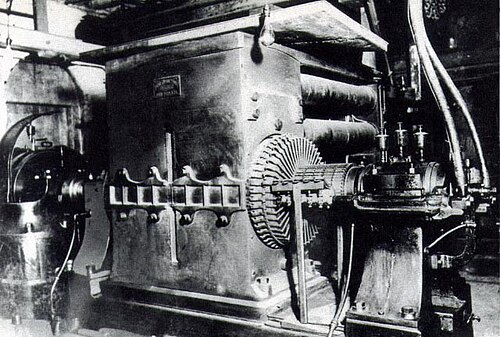
Edison’s “Jumbo” dynamo at Pearl Street Station, New York, the first central power station in the United States (1882). Pearl Street ran on direct current, so it had no frequency at all. Image: Wikimedia Commons.
In 1882 Thomas Edison opened Pearl Street Station in New York. Steam engines drove dynamos, and cables ran from the station straight to the customers' lamps, within about a mile.
There was no Grid in our sense. There was a cable between the guy with the turbine and the guy with the light bulb. The owner of the station was the Grid.
Pearl Street used direct current at low voltage. That is why its reach was so short.
Direct current has no frequency. Frequency: no problem.
Power and Energy: kW and kWh
1891: Alternating Current Brings Frequency
Alternating current won the "war of the currents". With transformers, the voltage could be raised for long distances and lowered again for the user.
In 1891 a three-phase line carried power 175 km from Lauffen am Neckar to the electrical exhibition in Frankfurt am Main, at 40 Hz.
With alternating current comes frequency. In a small system with one generator, frequency is simply how fast the generator turns.
Every town chose its own. Europe used everything from 25 Hz to 60 Hz before slowly settling on 50 Hz.
Still no problem. Each station fed its own lamps at its own frequency, and lamps barely notice.
AC vs DC: Why the Transformer Won
1890s: Frequency Becomes a Problem
Two things changed.
First, electric motors. An alternating-current motor turns at a speed set by the frequency. When the frequency drops, the machines in the factory slow down with it. Now frequency matters to the user.
Second, stations get connected. Two generators on the same wires must turn in step, at exactly the same frequency.
From here on, frequency is a problem, and somebody has to keep it steady.
Load Slows the Generator
When someone switches on a large motor, the load pulls on the shaft. The generator slows down, and the frequency drops.
Less load: the generator speeds up, and the frequency rises.
So frequency is a signal. It tells everyone, at the same moment, whether there is too little or too much generation.
The Governor and the Stoker
Two things keep the speed steady.
The first is the governor, a speed controller on the engine. The classic one has two heavy metal balls spinning on a shaft. When the engine slows, the balls drop inward, and that opens the steam valve.
The second is the stoker. He watches the boiler pressure gauge. When the engine uses more steam, the pressure drops, and he feeds the fire harder.
If there is not enough steam, the valve is wide open and the engine still cannot give more. The frequency keeps falling. Some customers have to be disconnected (load shedding), or the system collapses: a blackout.
What is Inertia?
Inertia is the resistance of a heavy spinning mass to changing its speed. Think of a heavy flywheel: it is hard to slow down.
A large rotor spinning fast stores a lot of kinetic energy. When the load jumps, that energy is drained first, before the speed drops noticeably. Inertia buys time for the governor and the stoker.
Inertia is not how fast a power plant can change its output. A nuclear plant is slow to change its output, but its huge turbine gives plenty of inertia. Slowness of output is called ramp rate, or flexibility.
With one small generator there is little inertia, and the frequency swings a lot. With only lamps attached, nobody cared. With motors and a second generator, it starts to matter.
Two Generators
Connect a second generator to the same wires, and the two lock together. They spin at exactly the same frequency.
When the load rises, both see the same frequency drop. Each adds power in proportion to its size, because their governors use the same "droop" setting. The big one takes the big share.
Their spinning masses add up. More inertia, steadier frequency.
Independent, but Coupled
The generators can belong to different owners. They are independent as businesses, but coupled electrically.
If one fails, the others must take its load at once. If they cannot, they slow down, protection trips more of them, and the failure accelerates: a cascading failure. This is how many real blackouts happen.
This is why grids keep spare capacity running, called spinning reserve.
Protection: Breakers and Arcs
Black Start: Restarting a Dead Grid
1920s: Somebody Takes Care of the Cable
Once several stations share the wires, somebody has to take care of the cable. Figuratively speaking, the guy with the turbine lets go of the cable and focuses on the turbine.
In Britain, the Central Electricity Board was created in 1926 to build a national grid. In Germany, RWE built a north-south line around 1930, linking Rhineland coal with Alpine hydropower.
The first obligation of the people who took care of the cable was balancing: keep generation equal to demand, so the frequency stays at its nominal value.
They watched frequency meters. A common early type was the vibrating-reed meter: a row of small steel reeds, each tuned to a slightly different frequency. The reed that vibrates most shows the current frequency.
When the frequency fell, they phoned the power stations: "add ten megawatts", "start another boiler". This is the origin of dispatching.
1950s: Grids Connect to Grids
Next, grids connect to grids. Cities, then regions, then countries.
In 1951 the western European grid operators founded the UCPTE to coordinate. In 1958 the grids of Germany, France and Switzerland were joined at Laufenburg, the "Star of Laufenburg".
Today the Continental European grid runs at one 50 Hz from Portugal to Turkey. Ukraine and Moldova joined in 2022, the Baltic states in February 2025. Thousands of generators spin together, and their combined inertia makes the frequency very steady.
Size brings new problems. A disturbance does not reach everyone at once: the change in frequency travels across the Grid as a wave, from rotor to rotor, at several hundred kilometres per second. Across a country like Britain that takes a second or two. Fast for humans, slow for electronics.
And large areas can swing against each other. More on that below.
Voltage Levels: From 380 kV to Your Socket
Voltage and Reactive Power
Grid Strength: Short-Circuit Power
1990s: Turbine and Cable Become Separate Companies
For most of the 20th century, one company owned everything: the power stations and the wires.
In the 1990s Europe liberalised electricity. Generation, trading and the grid were separated ("unbundling"). Grid operators became companies of their own, with one job: run the network and keep the frequency in check.
This legal separation is where the meter gets its meaning.
Who's Who: TSO, DSO, Supplier, Balance Responsible Party
Behind-the-Meter (BTM) and In-Front-of-the-Meter (FTM)
The Grid both ends and does not end at your Grid Power Meter.
The Grid Power Meter demarcates two legal, but not electrical spaces: in-front-of-the-meter (FTM) and behind-the-meter (BTM)
From an electrical point of view in-front-of-the-meter (FTM) and behind-the-meter (BTM) is the same space.
Flow of Electricity vs Flow of Water
There are a number of misunderstanding in relation to the Grid, and I have been looking for a suitable metaphor to help me talk about them.
The closest metaphor would be the flow of water and it does not work.
Electricity and water behave in fundamentally different ways.
The most significant difference, is that water flow is controlled at the valve, which is not applicable to electricity. The flow of electricity is controlled at the source.
This means, that when the sun is shining and your solar panels produce more electricity, than you consume, and you should not deliver to the Grid; what you do is reduce the production. There is no valve between your solar production and the grid you can close.
Challenges Facing the Grid
When talking about the challenges facing the Grid, the common sense is an amalgamation of the two core challenges: "throughput" and "balance/imbalance". These are commonly amalgamated into "what the grid can do". And into "make the grid able to do more".
To properly understand and act upon the future of grid one should learn the difference.
Throughput
Throughput (transmission and distribution capacity)
Upgrading throughput—e.g., adding high-voltage lines or smart grid tech—lets you move more power, but it doesn’t by itself ensure that generation matches consumption at every moment.
So, upgrading the Grid for throughput addresses (and I am on purpose not saying "fixes") only half of the problem.
Balance/Imbalance
Supply and demand balance (balancing generation with consumption)
Upgrading throughput—e.g., adding high-voltage lines or smart grid tech—lets you move more power, but it doesn’t by itself ensure that generation matches consumption at every moment. You still need mechanisms like storage, demand response, or flexible generation to handle the supply–demand problem.
Congestion: Redispatch, Curtailment, Bidding Zones
Grid Connection: The New Scarce Resource
Grid and Nature
Ja, Vögel sterben jedes Jahr in Deutschland an Freileitungen und Masten durch tödliche Kollisionen und Stromschläge.In Deutschland verenden schätzungsweise 1 bis 2,8 Millionen Vögel jährlich an solchen Anlagen. https://niedersachsen.nabu.de/tiere-und-pflanzen/voegel/34803.html
In Deutschland sterben schätzungsweise 100.000 bis 250.000 Vögel jährlich durch Kollisionen mit Windkraftanlagen.
In Deutschland sterben schätzungsweise 100.000 bis 250.000 Vögel jährlich durch Kollisionen mit Windkraftanlagen.Einordnung im VergleichGlasscheiben: 100 bis 115 Millionen tote Vögel pro Jahr.Straßenverkehr: Rund 70 Millionen tote Vögel pro Jahr.Hauskatzen: 20 bis 100 Millionen tote Vögel pro Jahr.
Conclusion:
Less Grid is better for the nature.
Underground Cables and Acceptance
Grid and Energy Productoin
In an AC grid, generation must match consumption in real time. Any imbalance causes the grid frequency to deviate from its nominal value (50 Hz or 60 Hz). The system uses that frequency deviation as a feedback signal: if demand rises, frequency drops; generators automatically increase output (primary control), and additional reserves are dispatched (secondary/tertiary control) to restore balance.
Control Reserves: FCR, aFRR, mFRR
Tolerable variations
Frequency: Most grids allow ±0.5 Hz (sometimes ±1 Hz) for brief periods; sustained deviations outside ±0.1–0.2 Hz trigger protective actions.
Voltage: ±5 % is typical; beyond ±10 % risks equipment damage.
Time: Imbalances of seconds to minutes are managed by inertia and reserves; longer mismatches require curtailment, load shedding, or blackouts.
So the match must be precise in the long run, but the grid can tolerate small, short-lived deviations while control systems act to restore equilibrium.
Power Quality: Harmonics, Dips, Flicker
The Grid Today: Fewer Rotors, More Inverters
2000s: Inverters Arrive
Solar panels, batteries and most modern wind turbines are connected to the Grid through inverters: power electronics that turn their output into 50 Hz alternating current.
Nothing behind an inverter spins in sync with the Grid, so inverters bring no natural inertia. Modern heat pumps run their motors through electronics as well, so they are decoupled too.
Inverters are controlled by software, and they are fast. They can react within milliseconds. The flow of electricity is controlled at the source, and the source is now software.
DC Comes Back: HVDC and DC Microgrids
2006: One Line, Fifteen Million Households
On 4 November 2006, a high-voltage line over the river Ems in northern Germany was switched off so that a cruise ship could pass. Other lines overloaded and tripped one after another, and within seconds the European grid split into three islands.
In the western island there was too little generation, and the frequency fell to about 49 Hz. Automatic load shedding disconnected around 15 million households, most of them for less than two hours.
Independent, but coupled, at continental scale.
2012: The 50.2 Hz Problem
Early German rules told small solar inverters to switch off when the frequency rose to 50.2 Hz. Sensible for one device.
But Germany soon had many gigawatts of solar following the same rule. A small over-frequency would have disconnected all of them at the same instant, turning a small surplus into a large deficit.
From 2012 onwards, hundreds of thousands of installations were retrofitted. A setting that is safe for one device can be dangerous for a million.
2010s: The Grid Gets More Nervous
As coal plants close and inverters replace them, the Grid loses natural inertia.
After a fault, the frequency now changes faster. Engineers measure this as RoCoF, the rate of change of frequency. Less inertia, higher RoCoF, less time for everything else to react.
The devices become more agile, but the Grid itself becomes more nervous. Fast devices now have to react fast, just to keep things stable.
Two Kinds of Oscillation
Oscillation means something swinging back and forth.
The first kind is old: inter-area oscillation. Large groups of generators far apart swing against each other, and power sloshes back and forth across the continent. In Europe the west and the east swing slowly against each other, about once every four to seven seconds. Operators watch it constantly.
The second kind is new: inverter control oscillation. Inverter software reacts too eagerly to the Grid, overcorrects, and starts a fast back-and-forth swing of its own.
2020s: Everybody is a Producer
Today almost everybody can be a producer: solar on the roof, a battery in the basement, a heat pump, a wallbox, a production line with its own storage.
Above the inverters sits the energy management system (EMS), which carries out the behind-the-meter strategy. The inverter's own control works in milliseconds and keeps its output locked to the Grid. The EMS works in seconds to minutes and decides: charge the battery now, run the heat pump later.
An EMS can do this well or badly.
A good EMS smooths its changes and adds some randomness to its timing. A bad one slams power on and off and reacts to every small signal. If thousands of them react to the same price signal at the same moment, the Grid feels it.
Who Certifies the EMS?
Inverters must meet grid codes, such as VDE-AR-N 4105 in Germany. They are tested and certified for how they respond to voltage and frequency.
The EMS above them is mostly not certified for its grid behaviour. There is some movement, such as §14a EnWG, which lets grid operators dim controllable devices through the smart meter gateway, and EU cybersecurity rules. But a real certification of EMS grid behaviour is largely missing.
Partly, regulation follows only once something becomes big enough to cause trouble. Partly, an EMS is software that is updated constantly, which makes it hard to certify. And regulators have assumed that certifying the inverter underneath is enough.
It is not, once the inverter sits behind an EMS together with batteries and industrial equipment. A certified inverter only guarantees its own behaviour within its own limits. It cannot stop the EMS above it from commanding sudden swings, or many sites from doing the same thing at once. The behaviour that matters for the Grid emerges from the whole system, and nobody certifies that today.
The Digital Grid: Smart Meters and Cyber Security
2025: The Iberian Blackout
On 28 April 2025, Spain and Portugal went dark within seconds.
The final expert report, published in March 2026, found many interacting causes, among them oscillations, gaps in voltage control, and generators disconnecting one after another. There was no lack of energy. It was a failure of stability.
2026: Inertia Becomes a Product
Inertia is still needed. It buys the first few seconds after a fault, before other controls kick in.
It comes from whatever still spins in sync: nuclear, gas, hydro and the remaining coal plants, plus large industrial motors connected directly to the Grid.
New sources are added on purpose: synchronous condensers, large spinning machines that burn no fuel and exist only to spin, and grid-forming inverters, usually on batteries, which imitate inertia ("synthetic inertia").
Some new machines spin but are not synchronous. The Finnish company Teraloop builds hubless flywheels: a thin carbon-fibre ring, held by magnetic bearings, that stores energy as rotation. It spins at its own speed, not in step with the 50 Hz, so it reaches the Grid through power electronics. Its inertia is synthetic.
Since 22 January 2026, the four German transmission system operators pay for inertia (Momentanreserve) from synchronous machines and grid-forming inverters. Inertia has become something you can sell.
Many researchers argue that if inverters react fast enough, we will need much less physical inertia in future.
Physical vs Synthetic Inertia
Inertia comes in two kinds.
Physical inertia comes from a synchronous machine: a generator or motor whose rotor turns in step with the Grid's 50 Hz. The rotor is magnetically locked to the Grid. When the frequency dips, it gives up energy instantly. Its control software is the laws of physics: no bugs, no bad updates, no hesitation.
Synthetic inertia comes through an inverter, usually on a battery or a flywheel. The inverter measures the frequency, and software decides to respond. A grid-forming inverter sets its own voltage and frequency, like a generator, and pushes back as soon as the frequency moves. Fast and strong, but only as good as its software.
Even a flawless synthetic inertia still differs, with today's technology:
- Overload: in a fault, a synchronous machine briefly delivers five to seven times its rated current. An inverter's semiconductors allow about 1.2 to 1.5 times.
- Protection: protection relays were designed to detect those large fault currents. With inverters alone, they may not trip properly.
- Energy behind it: a rotor's energy is there as long as it spins. A battery or flywheel can be empty, or its capacity sold to another market.
The timing gap is mostly closing: grid-forming inverters react almost as fast as a rotor.
Measuring a Nervous Grid
What can be measured: frequency, voltage, current, power flows and phase angles, often with phasor measurement units (PMUs).
Inertia cannot be measured directly. You need a known change in power, and you watch how fast the frequency moves. A big power change with a slow frequency drift means lots of inertia.
The known change comes from a natural event, such as a power plant tripping, or from a deliberate pulse.
The British company Reactive Technologies does the second. It injects small, precisely timed power pulses and measures the response with sensors across the Grid. Britain's system operator uses it, and projects followed in Australia, Taiwan and New York.
Why so many sensors? Inertia is not spread evenly. Regions full of large rotors respond differently from regions full of wind and solar. Many sensors map inertia by region, beat background noise, and show how a disturbance travels across the network.
Is the Danger of Blackout Rising?
Both ways. More producers mean less dependence on any single plant, and fast, flexible devices can help a lot.
But low inertia, little visibility of millions of small systems, and badly behaved or herd-like energy management can make things riskier. It depends on rules and coordination, and on behaviour behind the meter.
Load Growth: Heat Pumps, EVs, Data Centres
Cheat Sheets
Time Scales: From Milliseconds to Years
Orders of Magnitude: From Watts to Gigawatts
Cost of Electricity vs Cost of Transport
How Electricity is Priced: Day-Ahead, Intraday, Merit Order
Balancing Groups and Imbalance Prices
How Grid Fees Work
Netherlands
Dutch grid tariffs.
Current tariffs are largely fixed and based on connection capacity and consumption
There are discussions about variable grid tariffs in the Netherlands
The Dutch government is addressing grid congestion with various measures
The Dutch government and grid operators (Liander, Enexis, Stedin, TenneT) are implementing other measures including regional tenders for flexible deployment starting in 2026, and procuring flexibility to free up capacity.